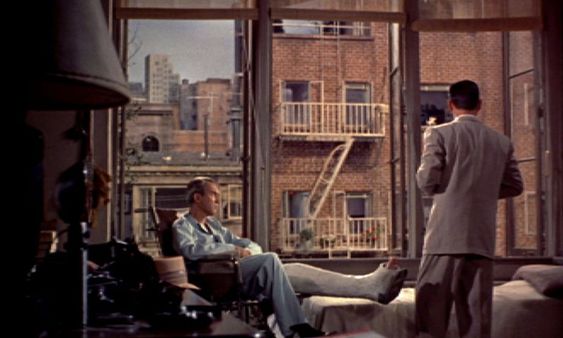
By the time director Alfred Hitchcock was preparing to film his mystery suspense thriller Rear Window in 1954, starring James Stewart and Grace Kelly, he had earned a reputation in Hollywood for being a master filmmaker with an eye for details. It should be no wonder, then, that Hitchcock pulled out all the stops to replicate a Greenwich Village courtyard inside Paramount Studios. Let’s see why the set of Rear Window was so impressive.
First, a bit about the movie itself. Rear Window starred James Stewart as a housebound man recovering from a broken leg in his Greenwich Village, New York, apartment. His beautiful girlfriend, played by Grace Kelly, and a home healthcare nurse, played by Thelma Ritter, stop by to care for him, but to pass the time, he sits at his window and watches the comings and goings of his neighbors. The suspense revs up when he witnesses some strange behavior that leads him to believe one of his neighbors is a murderer.
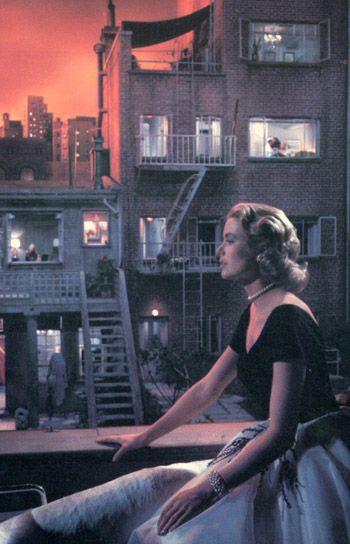
Rear Window is often cited as one of Alfred Hitchcock’s finest films and one of the greatest movies ever made. The stellar acting and exceptional cinematography, of course, contributed to that but the real wow factor was the set. Although he could have used several smaller sets and creative camera angles to depict the Greenwich Village courtyard, Hitchcock took advantage of his clout and reputation to take things to the next level with his set design for the film. And it paid off.
The set of Rear Window included the main apartment where James Stewart does his people watching, as well as thirty other apartments. Many of them were furnished, too. The set was one of the largest one’s ever built at that time and was so big that, to fit it into the Paramount studio, an entire floor of the building had to be removed. When completed, the set was nearly 100 feet wide, more than 180 feet long, and stood 40 feet high.
The set was fitted with more than a thousand lights that could be adjusted to recreate different times of the day and different weather conditions. A water and drainage system were also included in the set to make the rainstorm scene as realistic as possible, and to drain the water away afterwards. The entire thing was intricately painted so that the audience believed they were in New York’s Greenwich Village looking down on a courtyard. When it was complete, the set construction cost topped out at $100,000. That’s roughly the equivalent of $1.25 million in today’s money.
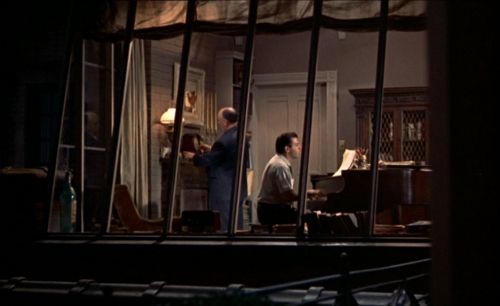
Alfred Hitchcock and his set designers also factored in sound when building the set for Rear Window. Hitchcock wanted sounds to naturally cross the courtyard and into the main apartment without the use of speakers that might distort the sound. He had selected several songs to be used in the film, including Bing Crosby’s “To See You Is to Love You”, Nat King Cole’s “Mona Lisa,” and Dean Martin’s “That’s Amore”, and he wanted the music to sound as pure and natural as possible.
Hitchcock accomplished what he set out to do. Rear Window garnered critical praise and accolades. At the 1955 Academy Awards, the film was nominated for awards in four categories, Best Director, Best Sound Recording, Best Adapted Screenplay, and Best Color Cinematography. It did not win any Oscars, however the film consistently ranks high on lists of the best movies from the Golden Age of Hollywood.