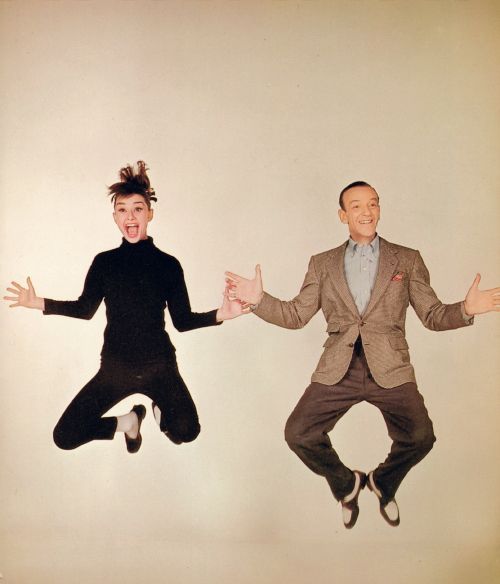
Funny Face, the 1957 romantic musical comedy written by Leonard Gershe and Stanley Donen, stars the unlikely couple of Audrey Hepburn, a 28-year-old fresh-faced beauty, opposite Fred Astaire, a 58-year-old former Vaudeville dancer. An age gap like this might seem creepy today, but in the Golden Age of Hollywood, moviegoers were used to seeing on-screen pairings of pretty, young ladies with much older men. Yet that is not the main theme of the film. Instead, Funny Face explores the conflict between brains and beauty.
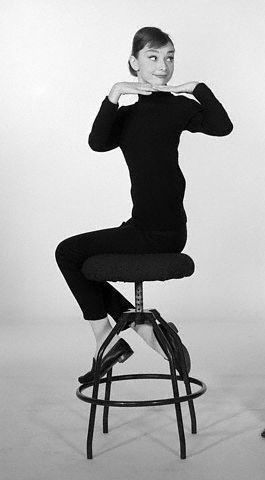
In Funny Face, Audrey Hepburn plays Jo Stockton, a brainy bookstore clerk in Greenwich Village. She is shy, bookish, and yearning to go to Paris to attend a series of philosophy lectures presented by a famous French professor. Fred Astaire plays fashion photographer Dick Avery, who is well-known in high fashion. When he stumbles into Jo’s bookstore, Dick is enamored by her geek-chic vibe and believes he can turn her into the next top model.
Serious and studious, however, Jo dismisses the fashion industry as superficial and degrading to intellect. But she does want to go to Paris. She cannot afford such a trip on her own, so she agrees to accompany Dick to Paris for a photo shoot. Naturally, Jo and Dick fall in love along the way. During the Paris photo shoot, Jo is at first viewed as an unconventional beauty because she doesn’t have the typical model look. As the photo shoot goes on, Jo comes to appreciate the creative process of fashion photography … and she learns how to embrace her unique brand of beauty.
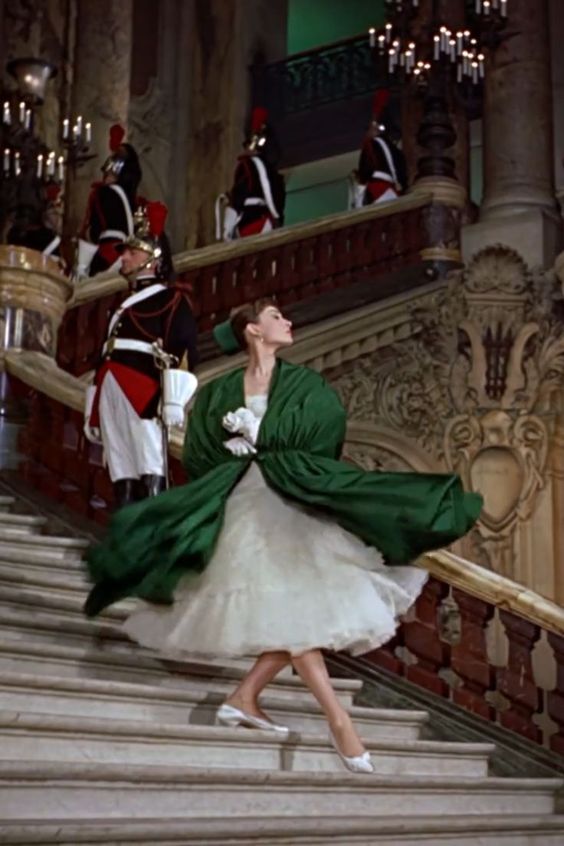
Let’s not forget that Funny Face was a musical. Audrey Hepburn shows off her singing chops by performing three songs for the film. One of them was a solo – “How Long Has This Been Going On?”, her first musical solo. She performed two duets for the movie as well, “S Wonderful” with Fred Astaire, and “On How to Be Lovely” with co-star Kay Thompson. She also participated in the ensemble scene featuring the song, “Bonjour, Paris!”
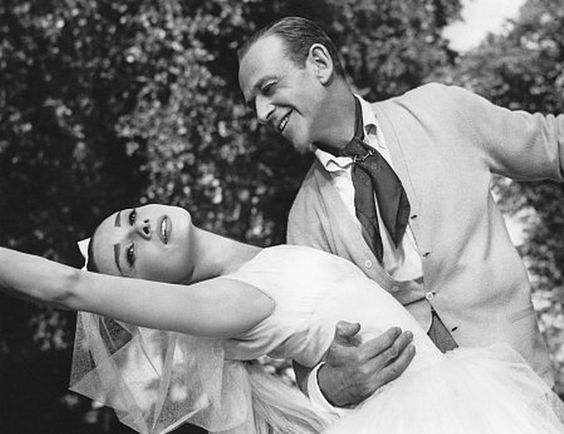
Because of his background as a dancer, Fred Astaire delivered captivating dance segments throughout Funny Face. He infused his dance numbers with a touch of humor and charm to highlight his character’s laid-back, casual persona. Hepburn was also trained in dance so she could hold her own with Astaire. Astaire and Hepburn’s dance scenes illustrated their on-screen chemistry.
Funny Face’s focus on fashion and photography forced audiences to think about the world of high fashion. It helped spotlight the process by which high-fashion photographers orchestrate fashion shoots to capture the images they want.
When Funny Face debuted in 1957, it was a flop. Box office ticket sales were so low that the film didn’t even break even. The movie studio, Paramount Pictures, deemed it a failure and shelved it … at least for a while. When Audrey Hepburn’s 1964 film, My Fair Lady, became a huge box-office hit with glowing reviews, Paramount decided to capitalize on the new popularity of Audrey Hepburn by re-releasing Funny Face. This time, the film fared much better. Folks flocked to see the movie and critics were overwhelmingly positive of Hepburn’s performance.
This time, Funny Face turned a hefty profit. The film left a lasting impact on pop culture and helped establish Hepburn as an icon of fashion. In fact, the fashion-forward themes of Funny Face, along with the style and fashion, songs and dances made this film a cult favorite.