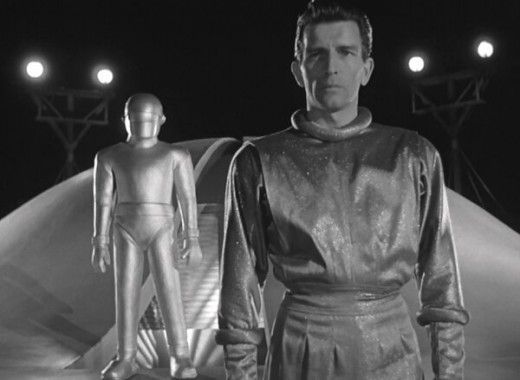
Science fiction films are one of the most popular movie genres today, but in the 1950s, before the space race and moon landing, Hollywood simply didn’t make a lot of sci-fi movies. A notable exception to that is 20th Century Fox’s The Day the Earth Stood Still, which debuted in 1951. Based on a 1940 short story called “Farewell to the Master”, written by Harry Bates, The Day the Earth Stood Still, directed by Robert Wise and produced by Julian Blaustein, was tweaked to include social commentary about the atomic age.
In The Day the Earth Stood Still, a humanoid-like space alien and a robot sidekick land on Earth to issue a dire warning to the humans. Humans had begun experimenting with rocketry and atomic weaponry, making the inhabitants of other planets concerned that Earthlings were becoming too aggressive.
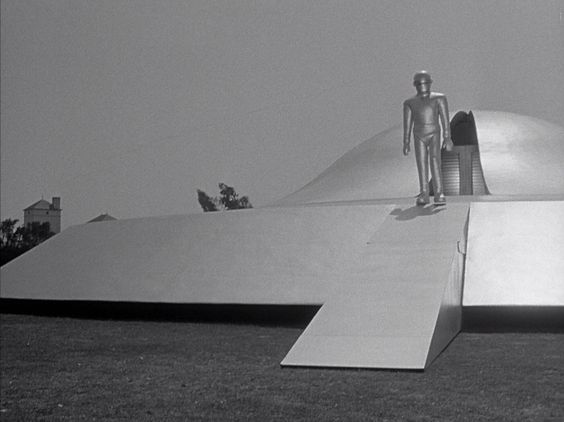
The film is set in the early days of the Cold War and when the nuclear arms race was getting started. Julian Blaustein purposely chose Bates’s short story for film adaptation because he wanted to make a movie that showcased the fear and suspicions of the time. The message of the movie is cautioning that scientific breakthroughs, like nuclear power, must not be used to make weapons of mass destruction or all the inhabitants of Earth may face the consequences. Blaustein even commented that he hoped the film would encourage a “strong United Nations.”
Surprisingly, it was not this anti-nuclear weapons message that upset the film censors. The Motion Picture Association of America’s film censor at 20th Century Fox, Joseph Breen, took issue with the scene in which the space alien (spoiler alert) dies and then is resurrected. The alien is also depicted as peace loving and having limitless power. Breen complained that Blaustein was making the alien into a Christ-like character. At the request of Breen and the MPAA, Blaustein added to the resurrection scene to have the alien explain that he was only temporarily brought back from the dead. The alien explains that the ability to make a permanent resurrection “is reserved for the Almighty Spirit.” The critic may have been correct that Blaustein wanted to compare the alien with Jesus Christ. In another scene, the alien steals clothing to disguise himself as a human. He uses the name he found sewn in the suit jacket and calls himself “Major Carpenter”.
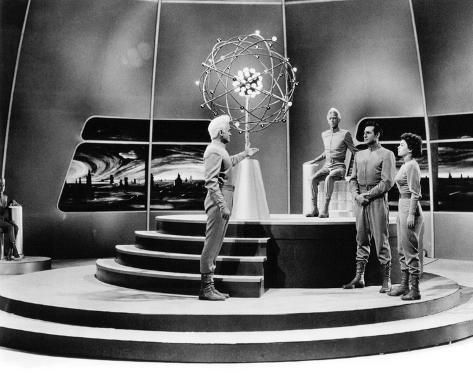
Famed architect Frank Lloyd Wright was brought in to work with the set designers for The Day the Earth Stood Still because Blaustein wanted to show a futuristic look for the interior of the spaceship.
Upon its release, The Day the Earth Stood Still was a moderate success. Most reviews, however, commented on the moralistic nature of the story. The special effects, although remedial by today’s standards, were also praised for being creative, innovative, and realistic. In the years after its release, The Day the Earth Stood Still has earned a cult following.