Gilbert Adrian – or just Adrian, if you want – was one of the most influential fashion designers of the 1930s and 1940s. His career was notable because the costumes he designed for the film industry also inspired fashion trends among celebrities and socialites. Sure, he famously designed the costumes for The Wizard and Oz, as well as hundreds of other films, but he also created glamorous gowns for some of the biggest stars of the Golden Age of Hollywood. Let’s look at the glitzy career of Adrian, one of the most prominent costume designers in cinematic history.
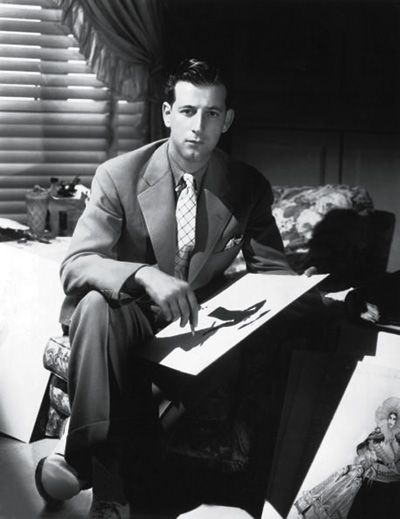
When he was born in 1903 in Naugatuck, Connecticut, he was given the name Adrian Adolph Greenburg. When he first started his fashion career, he adopted the name ‘Gilbert Adrian’, but that was eventually simplified to just ‘Adrian.’ When he was credited in films, the wording typically read ‘Gowns by Adrian.’
When Adrian was barely 18 years old, he enrolled in what was then called the New York School of Fine and Applied Arts, but we now know it as Parsons School of Design. Two years later, he transferred to the school’s Paris campus. Even as a student, his talents were obvious. During his time at the Paris location of the NYSFAA, Adrian was personally hired by Irving Berlin to design both the costumes and the sets for his Music Box Revie of 1922-23, which was performed in New York City.
With this impressive success to add to his resume, Adrian left New York City to head to Hollywood and the movie industry. His first job in Hollywood was for an independent film directed by Cecil B. DeMille, but in 1928, he signed a contract with Metro-Goldwyn-Mayer to be the studio’s chief costume designer. This was quite a coup for a 25-year-old fashion designer, especially when you realize that MGM was the largest and most powerful film studio at that time. Adrian remained in this role until 1941. During that time, he created costumes for more than 250 movies. He dressed many of the biggest stars of the Golden Age of Hollywood, including Katharine Hepburn, Greta Garbo, Joan Crawford, and Jean Harlow.
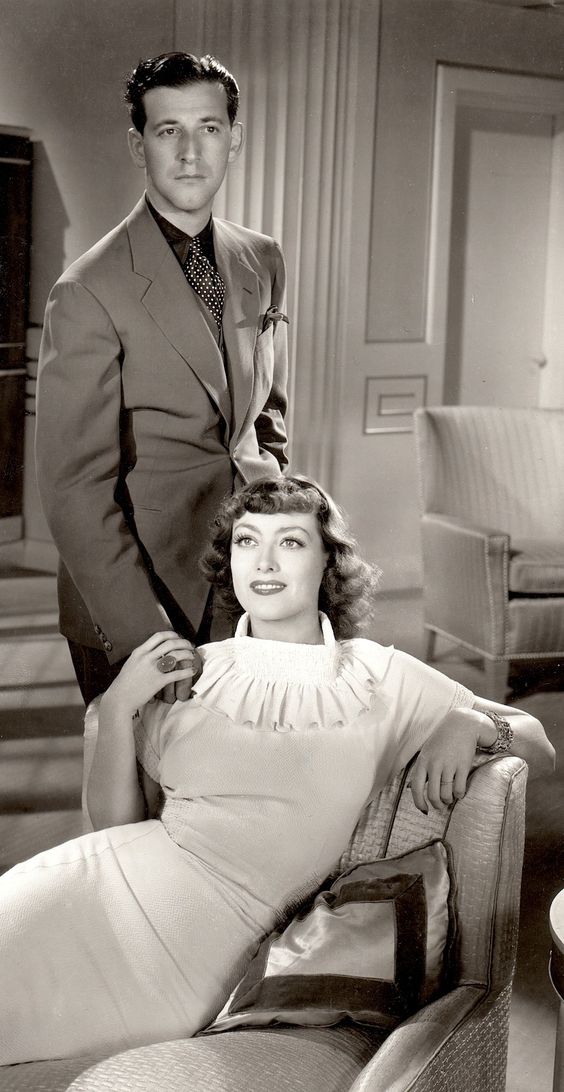
Adrian’s style was characterized by elegance, attention to detail, and sophistication. He earned a reputation for his impeccable tailoring, extravagant use of luxurious fabrics, and innovative design techniques. His designs were intended to emphasize the natural beauty of the actresses and to enhance their on-screen personas. Some of Adrian’s most famous works include the iconic ruby slippers worn by Judy Garland in the 1939 classic film, The Wizard of Oz, and the white organdy dress with a dramatic hoop skirt worn by Joan Crawford in the 1932 movie, Letty Lynton.
For the 1930 film, Romance, Adrian designed a Eugenie hat for the movie’s star, Greta Garbo. This hat kicked off a fashion fad that swept across the country. For several of the 28 movies he worked on that starred Joan Crawford, Adrian used shoulder pads to accentuate her silhouette. In doing so, he started a trend that saw padded shoulders popping up in women’s clothing in the years after. Thanks to Adrian, Katharine Hepburn’s androgynous outfits made her a trendsetter during the 1940s. He helped her pair classic slacks with men’s style button-down shirts that launched the menswear movement among women’s fashion.
If you have seen the 1936’s films The Great Ziegfeld, Camille, or Romeo and Juliet, or the 1940’s movies Strange Cargo, New Moon, Pride and Prejudice, or The Philadelphia Story, then you are familiar with Adrian’s work. Among his other credits were The Women in 1938, When Ladies Meet in 1941, Woman of the Year in 1942, Possessed in 1947, and Lovely to Look At in 1952.
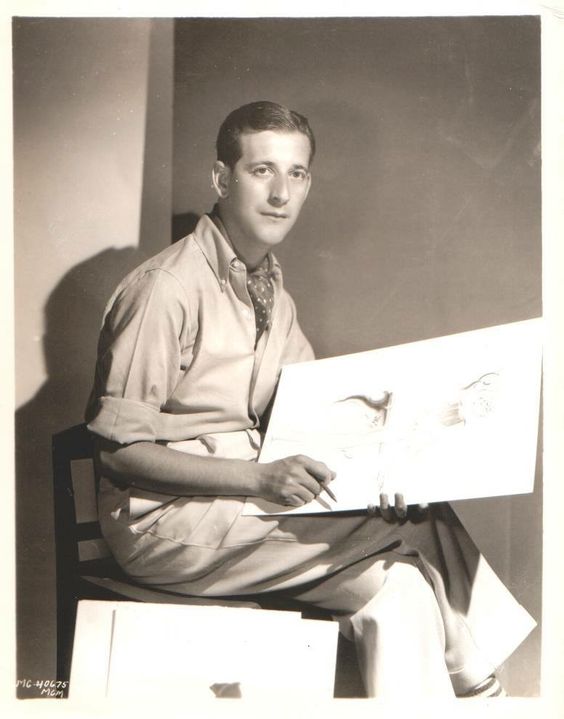
Perhaps Adrian’s greatest strength was in designing stunning, show-stopping evening gowns. He was the king of the slinky, silky evening gown. This talent was on full display in the 1938 movie, The Women. Although The Women was shot in black and white, one scene, featuring a fashion show of Adrian’s gowns, was filmed in Technicolor.
In 1941, Adrian departed ways with MGM. Just because he left the film industry, didn’t mean he was finished with fashion. He opened his own fashion house in the heart of Beverly Hills and continued to design creative and innovative evening gowns for a list of private clients that read like a Who’s Who of the rich and famous of the 1930s and 1940s. He also penned numerous books on fashion and costume design, so his legacy has outlived him.
On August 14, 1939, Adrian got married to actress Janet Gaynor. Although the couple both maintained that they were happily married, their relationship was considered to be one of several ‘lavender marriages’ that were common in Hollywood in that era. Adrian was openly gay and did not attempt to hide this. As for Janet Gaynor, it was whispered that she was also gay, perhaps bisexual. In 1940, however, the couple had their only child, a son named Robin.
Adrian’s Hollywood career helped to define the glamorous aesthetic associated with the Golden Age. His designs were highly sought after by both actresses and wealthy, fashionable women outside the film industry. He was a trendsetter and fad creator. Adrian had a tremendous influence on the fashion industry as a whole and his work continues to inspire designers today, even though he died on September 13, 1959.